The psychopomp-control rule
The Dark HalfThe psychopomp-control rule is the warning that no person can command the sparrows—the agents of the afterlife—for long, and that attempting to do so exacts a price. It turns the flock from an apparent instrument of human will into an independent force: silent, watchful, and capable of choosing when to approach. Its final meaning is inseparable from George Stark’s destruction and Thad’s unresolved question about whether the debt has already been paid.
The Flock’s Presence and Apparent Intent
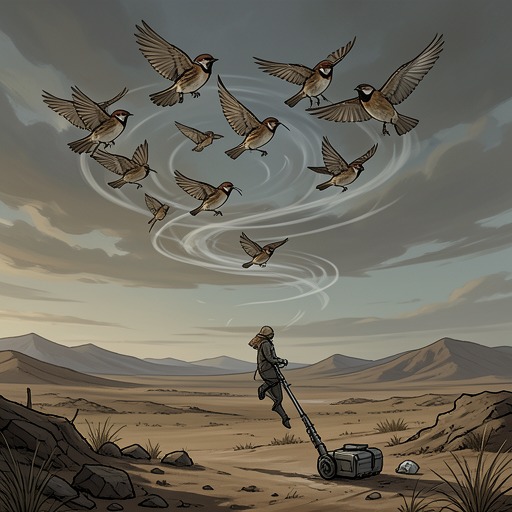
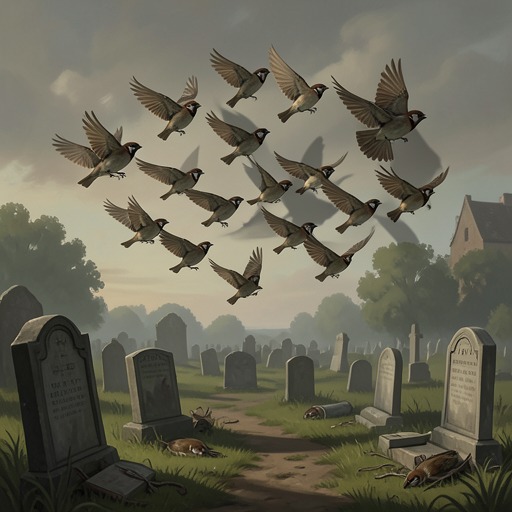
The rule emerges against a pattern of collective arrival that is both immense and unnervingly quiet. At Gold’s Junkyard and Auto Supply, Thad and Rawlie DeLesseps find the dead cars and trucks across the back ten acres carpeted with sparrows. Thad has not heard them arrive. They occupy hoods, roofs, grilles, engine blocks, and the spaces beneath the vehicles, while Rawlie recognizes them as psychopomps and asks what their appearance means. Their silence and sheer numbers make the flock feel less like ordinary wildlife than a gathering with purpose.
The birds’ approach to Alan Pangborn suggests that their presence is not simply an indiscriminate attack. One lands on his shoulder, hops onto his hand, and lowers its beak as if to peck his palm, but stops. It then returns to the driveway and stares up at him. Alan’s startled questions receive no answer; the sparrows continue watching while the trees across the lakeside fill with birds and a branch cracks beneath their accumulated weight. The scene grants the flock an unnerving capacity for proximity and restraint without explaining its intentions in human terms.
For Thad, the same presence becomes a physical barrier. A sparrow lands on the hood of his Volkswagen and peers in with what he senses as frightening, dispassionate curiosity. The flock fills the road ahead so completely that the birds are not merely in the way; they are the way. Thad understands that reaching the house requires driving over them. After he does so, he stops in the clear and vomits, looking back at a silent world occupied by the psychopomps. His fear is not only of the act itself, but of what might happen if George were somehow to gain control of the birds.
Rule of Control and Cost
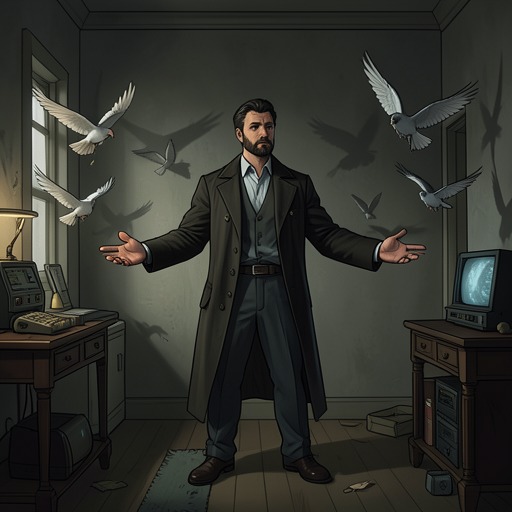
The climactic warning gives these encounters their governing principle: no one controls the agents of the afterlife for long, and there is always a price. The rule is not presented as a reliable technique or a promise that the sparrows will obey whoever invokes them. Instead, the flock’s independent movements—appearing without sound, pausing at Alan’s hand, and gathering along Thad’s route—make human control seem uncertain even before the final confrontation.
That uncertainty matters because the birds can be mistaken for a force a person might direct toward a desired outcome. Thad’s fear that George could gain control of them makes the danger explicit: if the flock could be turned to serve Stark, its power might become another weapon in the crisis. But the conclusion refuses to confirm that anyone has mastered it. The rule puts a limit on human command, not a set of instructions for exercising it safely.
The price is just as unresolved as the degree of control. After the flock carries out its final intervention, Thad wonders what he will have to pay and when the bill will come due. He also considers the possibility that the cost has already been paid and that he is finally even. These are possibilities rather than a definitive accounting: the narration leaves open whether the sparrow’s actions have demanded a future sacrifice, settled an existing debt, or done both.
Stark’s Escort and the Warning’s Fulfillment
At the climax, the psychopomps reveal what their arrival has been leading toward. They have come to serve as George Stark’s escort back to Endsville, the land of the dead. As Thad retreats toward his children, the door opens further and sparrows fill the air. They settle on Stark’s shoulders, arms, and head, then strike his chest in growing numbers. Stark twists beneath their beating wings and slashing beaks, trying to return the violence as the flock overwhelms him.
The escort makes the rule more than a general statement about supernatural limits. The sparrows are not merely a resource in the human struggle; at the decisive moment they act as agents whose purpose is to carry Stark away. Their violence accomplishes what the confrontation requires, but the narrative does not describe them as tame or safely commanded. They arrive in a force of their own, and Thad drops his pencil and withdraws toward his children as the birds take over the space.
Afterward, the last sparrow’s departure leaves Thad with no comforting explanation. Liz asks why it behaved as it did, and Thad thinks it may have been moved by a force intent on reminding him that the encounter was not a fairy tale. The admonition follows: no person controls the agents of the afterlife for long, and there is always a price. Thad’s private questions about when the bill will arrive, and whether it has perhaps already been paid, keep the rule active beyond Stark’s defeat. The flock’s departure ends its immediate intervention, but not the uncertainty around what its help has cost.